
Forget Palm Beach. Wellington Has Plenty of Wealth-and All The Horses
Updated: Sep 15
Forty minutes inland from the power and pomp of Palm Beach lies a greener, but no less gilded, Florida enclave. In this Year of the Horse, Elise Taylor goes inside the winter equestrian capital of the world.
Elise Taylor | Photos by Tina Tyrell | 7 May, 2026 | Vanity Fair
Last year, Kelly Killoren Bensimon, a former cast member of The Real Housewives ofNew York City, got a call from a Hollywood producer. He had an idea for a reality television show about Wellington-a village in Palm Beach County, Florida, known for its equestrian residents, from polo players to showjumpers to dressage riders. He knew Bensimon, an amateur show jumper herself, was "horse-world-adjacent." Did she have any thoughts? Only a blunt one: "That's never going to work," Bensimon told him. There are the worlds we live in, the worlds we wished we lived in, and the worlds we never even knew existed. For most of us, Wellington belongs to the last. In fact, if you ever randomly found yourself there-which is unlikely, as it's smack-dab in the middle of swampland and 40 minutes inland from the ritzy, ocean-breezed boulevards of Palm Beach-you probably wouldn't know it. There's no main street, only a series of shopping centers with stores you could find in Anytown, USA: Lowe's, TJ Maxx, Starbucks, Whole Foods. The nicest hotel is the three-star Hampton Inn & Suites. Yet for a small, small circle-those on the elite international horse show circuit-Wellington isn't a drive-through town. It's a mecca.
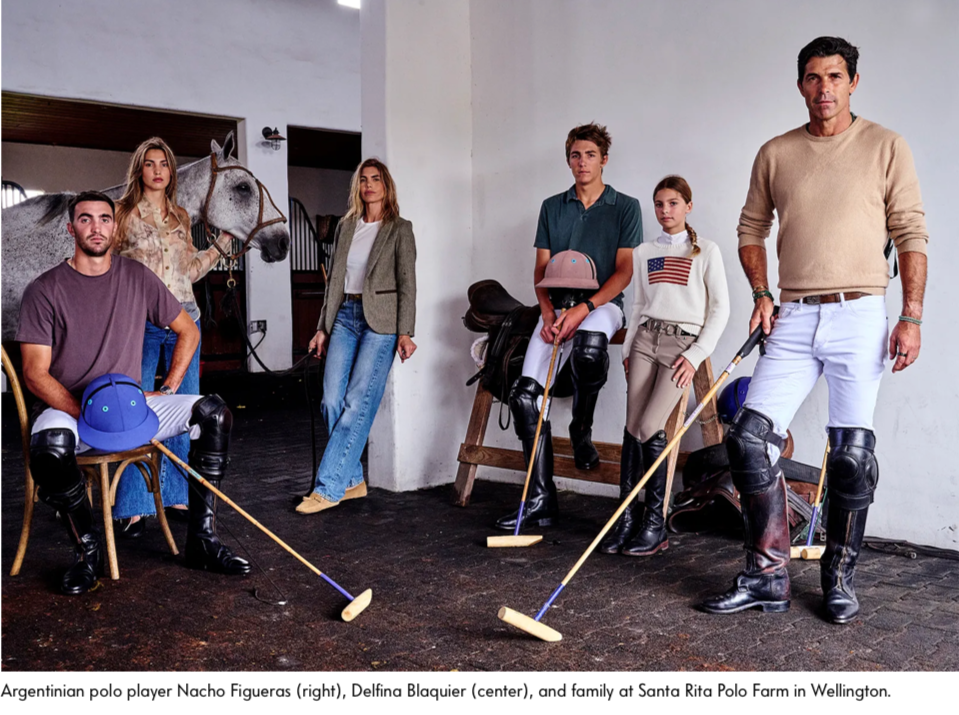
Behind gates (and gates behind gates) are green, swamp-drained pastures housing mansions, polo fields, stables, and horses that can cost up to seven figures. They can be owned by wealthy people indulging in an expensive hobby or an Olympic athlete talented enough to make a living from this niche sport. "The Wellington world is a very insular, small world. It's a very specific asset class-and people of ultrahigh net worth don't want to have their asset class exposed," Bensimon tells me from West Palm Beach, where she's currently filming a forthcoming E! show, The Golden Life. "Who wants to have what they're doing and how they're doing it exposed on the world stage?"
"You have to have multiple horses," says Bensimon. "You have to have trainers. You have to fly to Europe."
It's an awkward question for me, because,well, that was exactly what I was trying to do. Although exposedisn't quite right-I wasn't looking to stir up TV-worthy drama. But I was curious. I first heard of Wellington during my tony private school days in Greenwich, Connecticut. Several of my classmates disappeared on Fridays, getting an "excused absence" during the winters to head to Florida. Teen me was justjealous. One day I asked my father ifI could try riding. He didn't even look up from his newspaper: "No." Who could blame him? Equestrianism-along with polo, skiing, and sailing-is one ofthe most expensive sports your kid can choose: You need not only to lease a horse but also to pay for the stable fees, the veterinary appointments, and the farrier care (not anyone can put a horseshoe on a hoof). And ifI somehow got good enough to regularly compete, there's flights and lodging-for me,a parent, and that hypothetical horse (or two or three, as they're living creatures who need rest) too. "You have to have multiple horses. You have to have trainers. You have to fly to Europe. Your horse essentially gets a horsekeeper, a nanny, a bougie apartment, and an incredible professor-the trainers in Wellington are like Harvard [professors] in the world of academics. They are the best ofthe best," says Bensimon.

Once you learn of Wellington, you may see subtle signs of it everywhere: Eve Jobs and Bella Hadid, posting on Instagram from Wellington after walking the runways of Paris. Prince Harry and Meghan Markle, kissing at the Grand Champions Polo Club as his team won the Royal Salute Polo Challenge. Tabloid reports that Madonna wanted to buy a mansion in Wellington because, in her 40s, she had fallen in love with horses-even though she broke several bones in a 2005 riding accident.
A horsey history lesson: In 1951, an accountant and aviation enthusiast named Charles Wellington bought and drained 18,000 acres on the edge of the Everglades. He built a ranch as well as a landing strip for his planes. Nearly three decades-and multiple developers-later, much ofWellington's original property was sold to a Chicago company called Gould Inc.
William Ylvisaker was an avid Yale-educated polo player amid the sport's decline in the United States: Before World War II, many moneyed cavalry soldiers picked up polo for fun while in the service and continued to play it well after they left. As horses on the battlefront became obsolete as technology (and tanks) advanced, American polo was left with a serious pipeline problem. Ylvisaker had a Field of Dreams approach: He would build a world-class polo facility called the Palm Beach Polo & Country Club for the sport's remaining enthusiasts and possibly inspire some new ones in the process.

Ylvisaker also brought another horseman into the fold: Gene Mische, a businessman who produced professional equestrian shows in Florida. In 1977 the first weeklong Winter Equestrian Festival was held. Over the decades, Wellington became the capital for every discipline of equestrian sports: not only polo and show jumping but also show hunting (where a rider is judged on a horse's movement, style, manners, and jumping form) and dressage (which focuses on precise, fluid movements between horse and rider, giving it the nickname of horse ballet). A 1981 ad in Vogue boasted about the luxury leisure lifestyle one could find in Wellington: "Come enjoy the ambience and hellfor-leather excitement-the fast horses, sparkling champagne, and scintillating people that surround the regal sport of polo. Come join counts and cowboys, princesses and playboys, allplaying life to the hilt at America's most regal resort community."

It worked. Prince Charles came to play multiple times, even bringing along his young wife, Princess Diana, in 1985. (Ylvisaker reportedly offered the prince a home in Wellington as a wedding present, but the offer was never accepted. The villa was later purchased by Zsa Zsa Gabor.)
Today, show jumping is arguably Wellington's most visible sport. More than 300,000 spectators flock to town to watch more than 4,436 unique competitors from 55 countries compete in the Winter Equestrian Festival (WEF), now a 13-week circuit. It culminates in the Rolex Finale Week, where the top-ranked riders in the world-meaning they and their horses can jump more than five feet-compete for amillion-dollar prize purse in the Rolex US Equestrian Open Grand Prix. There are no categories-in show jumping, men and women compete together.

Those atthe five-star level are serious athletes. For the Rolex Grand Prix, the athletes and their horses leap through a track of 14 different obstacles-walls, gates, oxers, verticals, open water-without knocking anything over and in a set amount oftime determined by the course designer. Or as Richard Vogel, the number three showjumper in the world and a Rolex testimonee (essentially a brand ambassador, the equivalent of getting sponsored by Nike as a basketball player), tells me: "Leave all the poles up and be faster than everyone else."
"One kid's asking you for a lip gloss and the other one needs an $8,000 saddle," says Bendet Eisner.
They also must do this with very little time to prepare: The athletes don't see the course until about an hour before they ride it, when they're allowed to do what's called a course walk. "If you want to compare with skiing-it's like a skier that doesn't know what downhill they'll need to ski down,"Vogel says. Wellington is just a long stop on a full competition calendar that includes the FEI World Cup Finals (held this year in Fort Worth) and CHIO Aachen in Germany (considered the Wimbledon of show jumping).
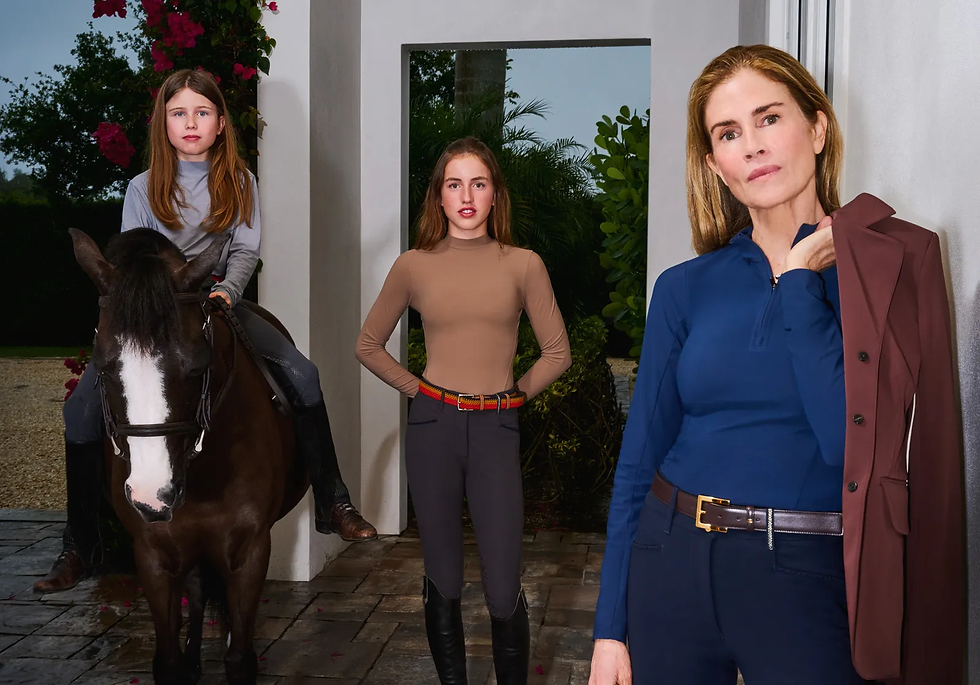
The WEF has a $536.2 million economic impact-more than the Miami Grand Prix ($505 million). Most of that comes from what's described as horse expenditures: essentially, allcosts associated with owning, caring for, and using a competition horse. And more than $100 million of that comes from nonresident-specific expenditures. In addition, many participants move to Wellington for the whole three-month season to compete. As a result, a number of high-end neighborhoods, where homes mix with stables and polo fields, have been developed within Wellington: Palm Beach Polo is still considered the ritziest. But there's also Palm Beach Point, the Equestrian Club, and Grand Prix Village. Some ofthese homeowners are professional equestrians. Others are riders who just have expendable income and do the sport as a hobby, akin to skiing or golfing.
There's also another group that occupies Wellington: teen horse girls with professional equestrian dreams and their parents. Those with enough capital often purchase homes or rent them for the season in an attempt to create some sort of domestic normalcy. Unlike myfather, Alice + Olivia founder Stacey Bendet Eisner said yes to her daughter Eloise when, at 10 years old, she attended pony summer camp in Malibu. Little did Bendet Eisner know it would lead to her becoming a Wellington resident. Because it turned out Eloise was good with horses. Like, really good: She started winning junior jumping competitions. Then there was the social media of it all. Eloise amassed more than 30,000 followers posting videos of herself riding on TikTok. Bendet Eisner, who was not experienced with horses, suddenly found herselfthrown into the surreal bubble of competitive equestrianism: "One kid's asking you for a lip gloss and the other one needs an $8,000 saddle," she says. "You're like, what?"

Gucci Westman's daughter, Gray, rides at the same barn as Bendet Eisner and follows a similar program: remote schooling for the winter, riding during early mornings, studying and more riding in the afternoons, competing on weekends. Due to her daughter's passion, the founder of Westman Atelier and her husband, Rag & Bone former co-chief executive officer David Neville, decided to relocate their family during competition season. Westman acknowledges that this all sounds "so privileged." Yet she had also asked her parents to allow her to take an unusual route. "Iwanted to become a makeup artist and go to makeup school in Paris so I didn't waste my time if Iwasn't good at makeup," she says. "I will never forget that feeling of them getting behind me in something that was not academic." What Gray was asking for, she figured, wasn't much different.
Just like most athletic hopefuls, most ofthose teens will not become professional equestrians. And the select few who do might not really make a living from it, spending much more than they make in an attempt to eke out a podium position. While in Wellington, the same juicy piece ofhorse gossip was repeated to me: A billionaire scion had spent something in the ballpark of $10 million to $12 million (the exact amount changed with the storyteller) on what they thought would be a winning horse. But the equestrian and the equine were like oil and water-"unrideable," an amateur rider tells me in a hushed tone, like she was repeating the illicit details of a terrible crime.

As much as F1 needs an equally good driver and car, equestrian sports have two extremely important variables: the horse and the rider.And unlike in F1, the second piece of the puzzle is a living, breathing, intelligent animal with its own mind and moods. "There's two athletes you need to train,"34-year-old Jessica Springsteen, daughter of Bruce, tells me as we sit outside in the Florida humidity by the bougainvilleas at her barn.
Springsteen is an accomplished professional athlete on the elite circuit: In 2021 she won a silver medal at the Tokyo Olympics for team jumping on her stallion Don Juan van de Donkhoeve. She has seven horses in Wellington. Some she shows on. Others are in development: While Springsteen herself has the experience to guide a horse over jumps higher than five feet, she needs a horse that knows (and wants) to do so as well. That takes years of training. So while she's competing in Wellington, she and her team are also preparing her next generation of equines. Unlike most athletes, equestrians peak in their 40s and 50s. Springsteen has a long career ahead, which will require multiple top horses.

"It's so hard to describe a feeling-youfeel like they know what you're thinking before you even ask them to do it," Springsteen says when I ask her what makes a good horse. "I have one mare, Naomi. If I'm in the air over a jump and I think I'm turning right, she is already ahead of me. When you get to that moment with a horse where you feel like they're reading your mind and you're so in sync-that only comes from time, putting in the work day-to-day, and learning from each other."
There's no horse more revered in Wellington than Greya, a mare that belongs to Kent Farrington. Farrington is currently the number two rider in the world-a ranking that, as I sit down with him at his Palm Beach Point stable the morning of the Rolex Grand Prix,I learn, bothers him. He's normally number one. Greya, meanwhile, set the record last year for the most five-star Grand Prix wins, with seven in a single season.

Before my trip, I called a few of my (to borrow a term from that Hollywood producer) "horse-world-adjacent" friends to talk about my agenda. Dropping Farrington's name was like telling a basketball fanatic I was interviewing LeBron James.
He is the horse GOАТ. He and Greya's origin story is repeated to me like a Greek myth: Whereas other equestrians at his level wrote multimillion dollar checks for their animals, Farrington bought Greya when she was young and unproven, before others perhaps realized the mare's potential to become one ofthe best jumping horses in the world.

When we meet, Farrington's on a tight schedule. He can give me and our photographer an hour, from 9 a.m. to 10 a.m. At 10, he's giving a tour to Rolex VIPs. (Like Vogel and Springsteen, he is also associated with the watch brand.) Then he needs to prepare for the finals.
There's no horse more revered in Wellington than Greya, a mare that belongs to Kent Farrington.
We walk around his vast, bucolic grounds deciding where to shoot. There's a horse walker, a merry-go-round-like machine to which horses are attached that leads them in a slow circle to warm them up. Standing by the practice ring is a forest green Rolex platform clock that casts a sundial-esque shadow on a basket weave brick path. Then there's the towering cream and brown wraparound barn. The warm-wooded stalls are so clean, spacious, and meticulously arranged with soft wood shavings that if Mary and Joseph stumbled upon them, they'd probably post up there even if there was room at the inn. A brown horse named Toulayna with a flower-shaped white spot on her head playfully sticks her muzzle out.I reach out to pet her-only to quickly retract. Is this one of those seven-figure horses? And if so...is it okay to pet a seven-figure horse?
Even this early, it's sweltering. Our makeup artist asks Farrington if he would like some powder as he wipes sweat off his brow. He shakes his head no, describing himself as more "American cowboy."

Farrington tells me how he got into riding: As a young boy in the Chicago area, he used to watch the carriages in the Lincoln Park area. The stable that housed them offered basic riding lessons. Farrington asked his parents if he could sign up.
A trainer at the small stable quickly recognized Farrington's promise. He took him to a better-equipped stable out in the suburbs. The trainers there recognized the same thing. Soon he was allowed to borrow horses for competitions. "I got a lot of industry support, and my parents supported me as much as they could," Farrington says. "Most ofmy early horses were off the racetrack that weren't good enough to race. The very first horse my parents got, my mom traded two used laptops for. And that was kind of how I began that journey."

After the hour is up, I drive my Jeep off Farrington's gated grounds to the next stop: Rushy Marsh Farm, to meet Karen Polle, a sponsored Hermès partner rider and Yale and Stanford graduate. Palm Beach Point is both idyllic and unknowable-all I can see is the green oftrees and the black of the road. All the homes and stables are tucked out of sight. Real estate listings show me what I can't see: $27 million equestrian estates with single-family homes, pools, stables, gazebos, stick-and-ball fields (a polo term), and in one case, a dedicated dog room.
I whip around a corner only to hit the brakes. A giant shiny silver horse transport-essentially a tractor trailer with a stable in the back-is making a sweeping turn. I spy a yellow sign ahead: "Horses Have the Right of Way."
That night, 10,000 people gather in the stands at Wellington International for the Grand Prix. There are a variety of concession stands selling french fries and chips and guacamole, as well as bulgogi. Children hop on an actual merry-go-round. But the main attraction-other than the competition itself-is a pop-up Hermès Sellier store, housed in a white clapboard structure in front of a palm tree.
Inside, it's elbow-to-elbow. The top-selling items, a shop assistant tells me, are the saddle pads (which retail around $700) and fly caps ($315). After several minutes of browsing, I step back outside to make room for the serious shoppers.


I sit inside a VIP tent as the competition begins. There's idle chatter among the guests as they dine on oysters and lobster tails. No one seems to be doing that well. One jump in particular, a solid green wall, seems to be giving everyone trouble. It sends one rider-and-horse pair tumbling to the ground-an almost violent act that breaks the leisurely trance in the tent as several people scream. When Farrington enters the ring on Greya, the whole stadium goes silent. They leap as one over everything in their path by what appears to be several inches.As they approach the wall, the woman behind me audibly winces in fear. Farrington and Greya clear that too, in one swift motion.
The pair decisively wins the Grand Prix that night. (Vogel comes in third.)
A Wellington reality television show never got off the ground, but the town might soon get the Hollywood treatment. In March the trade papers reported that Harry and Meghan, along with the creators of The O.C. and Gossip Girl, will be executive producers on a new drama series about polo players in Wellington.

And thanks to South Florida's population boom, real estate developers are descending on Wellington's pastures. Stephen Ross's Related Companies,which developed New York's Hudson Yards, has snapped up 71 acres. And Mark Bellissimo, the founder of Wellington Lifestyle Partners,is building a high-end commercial center that includes shops, restaurants, and a boutique hotel next to the festival's competition arenas. "They're bringing in landscape architecture from the Hamptons and buzzy architects, including one who did Pharrell Williams's Goodtime hotel in Miami. We have very efficient drive-in, getwhat-you-need in Wellington-from Publix or the pharmacy around Wellington. But to go to the really nice places, boutiques and really nice restaurants that don't feel like you're in the middle of a shopping center,you have to drive to Palm Beach," says Bellissimo's daughter Paige, who is president at Wellington Lifestyle Partners.I make a joke about the Hampton Inn & Suites. "The most expensive Hampton Inn and Fairfield Inn in all the land," Paige replies. During the high season, she's seen the cost go up to $800 per night.
Horse riding as a whole may be on the precipice of explosive popularity. Billionaire Frank McCourt-who once owned the Los Angeles Dodgers-recently founded the PremierJumping League, a new equestrian series with a $300 million prize pool that's set to begin in 2027 with competitions across Europe, North America, and the Middle East. McCourt partnered with the production company behind Netflix's Formula 1: Drive to Survive to film riders throughout the season. The wild, hushed world of Wellington may not be hidden behind those gates for long.


